Hi everyone! Dr Cosmo here.
If you’ve been told by your dentist that your tooth cannot be saved and would need to be extracted, perhaps you’re thinking about a replacement. Your dentist would’ve likely discussed replacement options such as a dental implant, a dental bridge or a denture.
You probably already know that the dental implant is usually the best option in returning function, aesthetics and form to your oral health. Dental implants are an amazing option for many patients to use as a way to eat their favourite foods and appear seamless with your smile. If done well, it’s difficult to notice the difference between your original tooth and the implant. This is why many dentists including myself highly recommend dental implants.
Normally after tooth extraction, within 1 year, you will lose an average of 50% of the width of bone in that area. If your dentist is concerned about severe destruction of residual bone walls after tooth extraction, he/she may recommend a socket preservation. They place bone grafting material into the socket with a membrane sutured on top to hold the bone graft while it integrates into your bone. This will minimise the amount of resorption that occurs in your natural healing of the bone, maximising bone for your future dental implant.
Case 1 – Hopeless upper right first molar due to periodontal disease
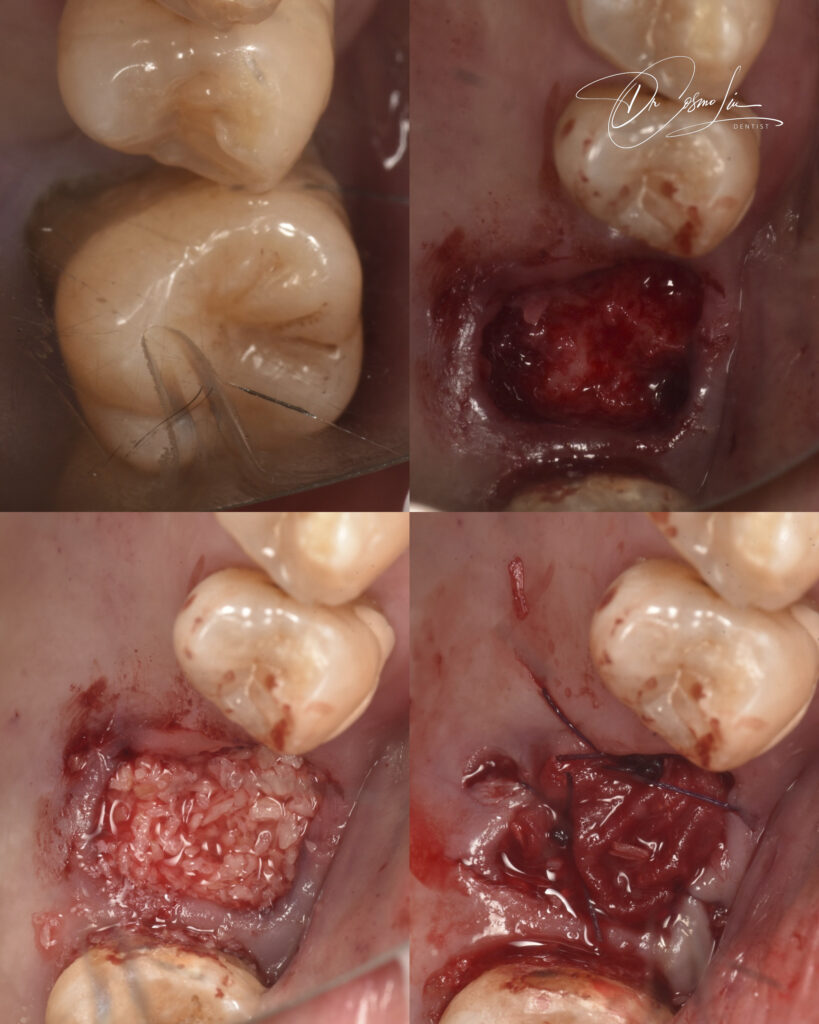
As you can see in the photo below, we have a tooth that has a hopeless prognosis due to localised periodontal disease. This means the tooth is very wobbly. This patient was unable to eat with that tooth as it caused pain when he bit down and chewed. Thus we had to extract, and curette the socket (meaning we clean the socket of any infection). Dental infections will increase bone resorption – hence it’s very important to clean extraction sockets properly before we place our bone graft.
Here I place MineraOss (allogenic bone), human bone ready for use in patients. It is completely safe, and there is no DNA in this treated bone graft material. I find the results with this particular bone graft to be the best when compared to synthetic bone and animal bone grafts. Allogenic bone is supported by research to yield the best results when compared to other bone grafts. You can see the clinical review of this particular product here: https://vsr.biohorizons.com/GetDocument?DocumentID=37694
Afterwards, we place a collagen barrier membrane with sutures over the bone graft. This holds the graft in place while it heals and maximises the potential for bone integration and healing. We review in four months to check the bone with a CBCT scan, then place the dental implant when the patient’s ready.
This procedure is not painful, and although it may appear confronting, it will not be worse than getting a tooth extracted as we are simply placing bone graft material with some sutures. During the procedure, you will be completely numb to any sensation. I always endeavour to deliver atraumatic extractions to facilitate the maximal bone preservation and minimize postoperative pain.
Contact us – Book now!
Follow @dr.cosmoliu or DM me there for more information on this particular procedure.
Thank you for reading! If you’d like to speak to a dentist, call to book your appointment now at Sydney Smile Care.