
Spot the Signs
Is your child’s smile developing as it should? As children grow, their teeth and jaws go through significant changes. While crooked teeth are common, certain signs may indicate that your child could benefit from an early orthodontic assessment.
But how do you know if your child actually needs braces?
At Sydney Smile Care Group, we believe understanding the early signs of orthodontic problems can help parents make informed decisions about their child’s dental health.
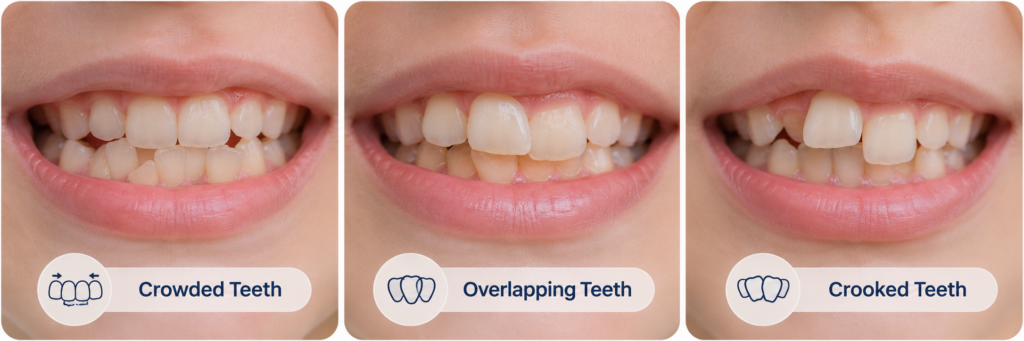
One of the most noticeable signs your child may need braces is crowded, overlapping or crooked teeth.
When there isn’t enough space for permanent teeth to grow into their correct positions, brushing and flossing can become more difficult, potentially increasing the risk of plaque buildup and tooth decay.
An early orthodontic assessment can help identify whether your child’s teeth have enough room to develop properly.
2. Difficulty Biting and Chewing
Does your child struggle to bite into food or complain about discomfort when chewing?
This could indicate a bite alignment problem, where the upper and lower teeth don’t meet correctly.
Orthodontic treatment may help improve bite function and make everyday activities like eating more comfortable.
3. Overbite, Underbite, Crossbite or Overjet
Not all orthodontic problems are immediately obvious.
Common bite problems include:
- Overbite: The upper front teeth overlap the lower front teeth excessively
- Underbite: The lower front teeth sit in front of the upper teeth.
- Crossbite: Some upper teeth bite inside the lower teeth.
- Overjet: The horizontal distance between the upper front teeth and the lower front teeth
These conditions can affect how your child’s teeth and jaws function. Identifying them early allows your dentist to recommend appropriate monitoring or treatment.
4. Early or Late Loss of Baby Teeth
Baby teeth play an important role in guiding permanent teeth into position.
Losing baby teeth unusually early or late may affect how adult teeth emerge, sometimes contributing to crowding or misalignment.
Regular children’s dental check-ups can help monitor tooth development and identify potential orthodontic concerns.
5. Persistent Thumb Sucking or Mouth Breathing
Did you know that certain childhood habits may influence dental development?
Prolonged thumb sucking, particularly beyond age five, can affect tooth alignment and bite development.
Persistent mouth breathing may also be associated with dental or jaw development concerns and should be assessed to identify its underlying cause.
Recognising these signs early can help parents understand when professional advice may be beneficial.
When Should Your Child First See an Orthodontist?
The Australian Society of Orthodontists recommends a first orthodontic assessment around age seven or eight.
At this age, your child has a combination of baby and permanent teeth, allowing dental professionals to assess developing alignment and bite concerns.
However, an early assessment doesn’t necessarily mean your child needs braces straight away. In many cases, monitoring their growth is the most appropriate next step.
A Healthy Smile Starts With Early Awareness
Every child’s smile develops differently, and not every crooked tooth requires braces.
At Sydney Smile Care Group, we’re here to support your child’s dental development with personalised care and professional guidance.
If you’ve noticed any of these signs, consider booking a children’s dental or orthodontic assessment with our friendly team.
Because a healthy smile begins with understanding your child’s needs.
Q&A
Can crooked teeth in children straighten naturally as they grow?
Some minor changes in tooth alignment can occur as a child’s jaw develops and permanent teeth emerge. However, significant crowding or misalignment may not resolve naturally.
If you’re concerned about your child’s crooked teeth, a professional dental assessment can help determine whether the condition is likely to improve with growth or may require orthodontic treatment.
What happens if orthodontic problems in children are left untreated?
Not every orthodontic concern requires immediate treatment. However, some untreated alignment or bite problems may become more difficult to manage as your child grows.
Depending on the condition, these issues can affect oral hygiene, chewing function and overall dental development. A dental professional can assess whether early intervention or ongoing monitoring is the most suitable approach.
Are braces the only option for correcting children's teeth?
No. Depending on your child’s age, dental development and orthodontic needs, treatment options may include traditional braces, clear aligners or other orthodontic appliances.
Some children may benefit from early orthodontic treatment, while others only need regular monitoring until their permanent teeth have developed further.
No responses yet